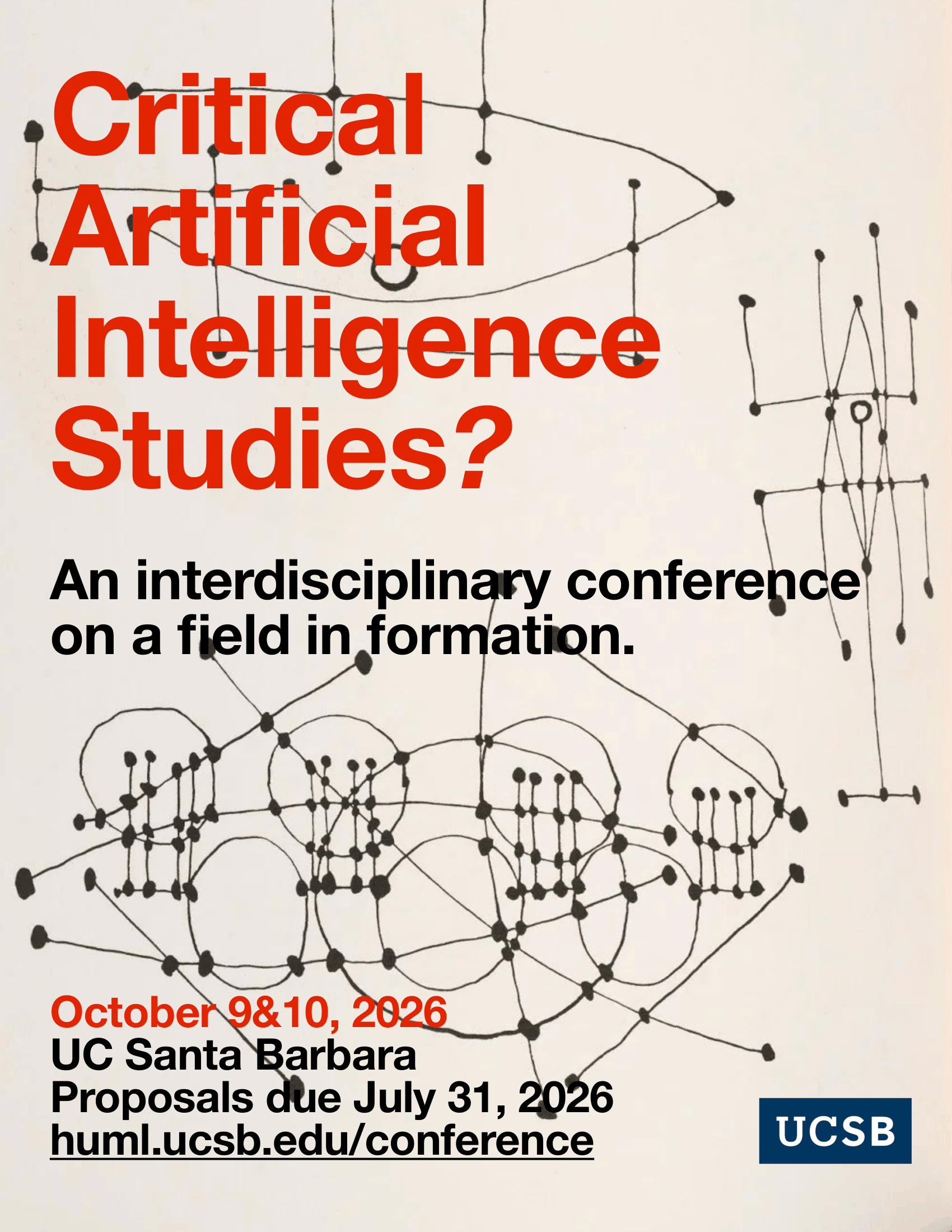
Call for Contributions: Critical AI Studies?
A conference to be hosted by the Center for the Humanities and Machine Learning at the University of California, Santa Barbara, October 9 & 10, 2026.
Nearly twenty years ago, Alan Liu warned that shallow interdisciplinarity often reduces the “other discipline” to a mere source of metaphors rather than systemic knowledge. “This is because its allure lies, not in knowledge at all, but in the new paradigms—which is to say, tropological figures rather than protocols—that it offers for representing the validity of home knowledge to itself” (Liu 2008). We are now living out that warning. Two decades into the deep learning revolution and four years after the public release of ChatGPT, artificial intelligence offers an extraordinary wealth of tropological figures to the humanities. AI is asked to inform discussions of political economy, intellectual labor, the climate emergency, the crisis of the university, the structure of language, the death of the author and the artist—in short, the whole canon of humanities discursive formations. But what would a humanistic engagement with AI itself look like—one that takes contemporary AI seriously as a technological rupture without disregarding the larger socio-economic context from which it emerges? In other words, if there exists an emerging discipline called critical AI studies, what, exactly, is its object and what are its methods? If not, which existing disciplines can lay claim to the various sociotechnical phenomena initiated by this rupture? Expanding Rita Raley’s and Jennifer Rhee’s (2023) call to examine the field in formation, the conference Critical AI Studies? sets out to lay the basic groundwork for answering these questions. To that end, we are seeking contributions that shine light on the disciplinary formation of critical AI studies, either by outlining its methodological, philosophical, and political challenges or by demonstrating paradigmatically what critical AI studies work looks like in the field. Some of the more specific “unsolved problems” of critical AI studies we are hoping to address are as follows:
- How can we frame the politics of AI in terms of its specific features as a media technology, without collapsing critical AI into a more general critique of racial capitalism? Given that AI maps power relations, how does it transform or distort the power relations it maps? What are the connection points between AI “economies” and actual economies? Where does neural exchange value (Impett and Offert 2026) meet real (venture) capital?
- What is the role of interpretation in critical AI studies? How do we interpret the outputs of generative AI systems when individual samples are not necessarily representative of the model that produces it, much less models in general? How can we arrive at a meaningful balance of “surface reading” (Bajohr 2025) and the analysis of model internals? How do we respond to the extensive technical literature on interpretability and avoid the misplaced confidence that the humanities enjoy a monopoly on interpretive practice?
- What is the status of theory in the broadest possible sense vis-a-vis AI? Are machine learning models and their outputs useful primarily as new objects for theory, that is, new grounds for the confirmation or contestation of existing disciplinary abstractions? Or does AI represent a meaningful sociotechnical paradigm shift, one that requires retooling earlier frameworks such as structuralism (Weatherby 2025)?
The conference will take place on October 9 & 10, 2026, on the University of California, Santa Barbara campus. We will be able to provide support for travel and accommodation for speakers as appropriate. We particularly encourage graduate students from within the UC system to apply.
To submit a proposal, please upload an abstract of approximately 500 words before references, as well as a biographical note of max. 100 words via this form no later than 31 July, 2026. For questions, please reach out to the organizers, Owen Leonard (owenleonard@ucsb.edu) and Fabian Offert (offert@ucsb.edu).